Tuesday, 24 July 2012

Kerala Destinations:Kottayam


Kottayam – Facts and Figures

Area 2204 sq. km
Population 1,82,8271
Languages Malayalam and English
Best time to visit September and February
STD code 0481


Eravikulam National Park, Eravikulam, Eravikulam Kerala, Eravikulam India, Travel Eravikulam, Kerala wildlife Eravikulam Kottayam – Introduction:
A chief trading hub of commercial produce and a publishing centre in Kerala, the town of Kottayam is also the administrative capital of Kottayam district. The town has been a forerunner of modern learning and education in Kerala since the nineteenth century.

Location of Kottayam:
Bordered by the Meenachil River and Kodoor River and Vembanad Lake, the town of Kottayam is considered to be part of the Midlands of Kerala. Located in the south-central part of Kerala, it is surrounded by Ernakulam to the north, Alappuzha to the west, Idukki to the east, and Pathanamthitta to the south of Kottayam. Kottayam was a portion of Travancore kingdom, before the creation of Kerala state.

Climate of Kottayam:
Like the other parts of Kerala Kottayam also has hot and humid climate. The temperature ranges between 23 degrees to 35 degrees centigrade during summer and 22 degrees to 32 degrees in winters. It experiences heavy showers brought by the monsoon clouds from June to September.

History of Kottayam:
Having derived its name from ‘Kotta Akam’ in Malayalam, meaning ‘inside the fort’, Kottayam or rather its region was ruled by the Rajas of Thekkumkur, an independent little kingdom. When, in the mid-18th century, Marthanda Varma of Travancore captured Thekkumcore, along with the areas of the rest of the present day Kottayam District, it became part of the Kingdom of Travancore (afterward to be the Princely State of Travancore under the British). After Indian independence, Kottayam in due course became the nerve center of the present Kottayam District.

Tourist Attractions in Kottayam:
Aruvikkuzhi Waterfalls, Elaveezha poonchira, Erumely, Thirunnakara Templethe beautiful Syrian Christian churches like St. Mary’s Orthodox Church and Valiapally are the various tourist sites to be visited in Kottayam.

Reaching Kottayam:

By Air: The nearest airport from Kottayam is the Cochin (Kochi) Airport situated at 76 km away. Also Thiruvananthapuram (Trivandrum) Airport lies at 160 km away.

By Rail: Kottayam is well linked with the chief towns within and outside Kerala by a fine rail network. The railway station is located barely 2 km away from the central bus stand. There are regular rail services available from Kottayam to Thiruvananthapuram, Kollam (165 km), and Ernakulam (65 km).

By Road: Good motorable roads connect Kottayam to the major cities of South India. You can avail of the bus services from the two bus stations, the Kerala State Road Transport Corporation bus station on T.B. Road and a private bus stand close to the railway station. Buses to the key centres ply from the KSRTC bus station.


Advertisement:

Saturday, 21 July 2012

Kerala Destinations:Kayamkulam


Kayamkulam is a tiny village located on the western belt of India in the state of Kerala. Situated on the banks of the Arabian Sea, the place is nearly equidistant from Alleppey and Kollam, both of which provide link with the stunning Kerala backwaters. The place is well connected by rail and road services to other cities in the area as well as other corners of the country.

Kayamkulam – Climate

The weather of Kayamkulam is pleasant all through the year. The monsoons begin from June/July and carries on till October/November. The temperature maintains a moderate level – neither too hot and nor too cold. 

Kayamkulam – History

Kayamkulam derived its name from the two words kayam (sap of a spice tree) and kulam (a pond). Kayamkulam was a part of erstwhile Travancore state for a long time and was a prominent center of art and architecture. Several temples and palaces were constructed during that period.

Description about Kayamkulam will be incomplete without the mention of Krishnapuram Palace. Located between Kayamkulam town and Oachira, the palace is an epitome of Travancore heritage. Home to the great king “Marthanda Varma” who was the ruler of Travancore, the palace has a pond within the premises. It is equally famous as the palace, if not more, as it is believed to have an under-ground channel that served as an escape way from enemies. The palace is now maintained by the Archeological Dept of Kerala and is preserved as a Museum. The Kayamkulam Sword which is well-known for its double edge is displayed here. The palace is also home to the statue of Buddha which is one of the four Buddha statues found from Kerala.


Advertisement:

Friday, 20 July 2012

Tour to Kochi

Culture, cuisine, and architecture mark the characteristics of a place to a large extent. Similarly, the cuisine, culture and architecture of Kochi speak volumes about the character of Kochi in the state of Kerala. On your tour to Kochi you ought to visit the various tourist attractions to soak in the flavor of the place. 


Situated in the district of Ernakulam, around 220 km to the north of the state capital, Thiruvananthapuram, Kochi has been influenced extensively by the Portuguese culture. Fort Kochi in Kochi happens to have been the first European colonial settlement in India. From 1503 to 1663, Fort Kochi was ruled by the Portuguese and accordingly, they have had tremendous influence in the culture, lifestyle and art and architecture of Kochi as well. However, there are influences of the Dutch also as they ruled the region later on.


St. Francis Church:

Famous for having contained the remains of the great Vasco da Gama at one point of time, St. Francis Church was built by the Europeans. Actually the Portuguese trader was visiting Kerala for the third time when he fell ill and died in Kochi. He was subsequently interned in the St. Francis Church. Nevertheless, later still, his remains were taken back to his homeland in Portugal. Till the present day, this church has the burial spot distinctly marked and is one of the most frequented tourist attractions in Cochin. 


Vasco House:

Situated on Rose Street, Vasco house is supposed to be one of the most ancient Portuguese houses in India. Vasco da Gama is said to have resided here. The house has beautiful European glass paned windows and verandahs.

Dutch Palace:

Originally built by the Portuguese, the Dutch Palace, located in Mattancherry, was afterward, in 17th century, modified by the Dutch and was presented to the Raja of Kochi. The palace has been witness to the coronation of many of the Rajas of Kochi. It is home to a fine collection of mural paintings illustrating scenes from the Hindu epics Mahabharata and Ramayana.

Jewish Synagogue and Jew Town, Mattancherry:

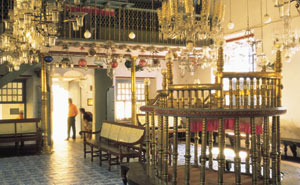
Situated near the Dutch Palace in Mattancherry, the synagogue, constructed in 1568, is beautifully decorated by Chinese tiles and huge Belgian chandeliers. Giant scrolls of the Old Testament are found here.

Santa Cruz Basilica: 

Erected by the Portuguese in 1505 and christened as a cathedral in 1558, the original church of Santa Cruz Basilica was renovated in 1905 after the British colonists had ruined the cathedral in 1795. In 1984 it was eventually raised to the status of a basilica by Pope John Paul II.

Evidently, most of the structures and buildings, that are a part of the Kochi architecture, reflect a strong Portuguese flavor in their architectural details. 


Advertisement

Wednesday, 18 July 2012

Shopping in Kochi


Shopping in kochi

A visit to any corner of the world demands a shopping spree where you can buy some of the distinctive products that speak of the culture of the place to return home with mementoes of the place visited and cherish them for the rest of one’s life. While you travel to Kochi you can afford to splurge a few bucks on various articles thus making the experience of shopping in Kochi really special.

If you are wondering as to what to buy in Kochi you have a large array of options. You can spend your money on items like handicrafts including bamboo, coir, shells, wood, brass, ivory, sandalwood products and spices and nuts all of which essentially speak of the essence of Cochin. 


Kochi also has a number of government stores which could be the most dependable and best bet for shopping in Kochi. These emporia display the finest of the handicrafts culture of Kerala and even often offer good amount of discounts on the items thus making Kochi shopping all the more interesting. Some of the standard government emporia in Cochin include the following:


  • Kerala State Handicraft Apex Society
  • Spices Board
  • Ernakulam Market 


  • There are numerous handicraft and antique emporia on M. G. Road and Marine Drive in Cochin. The Kerala State Handicrafts Development Showroom, Surabhi, State Handicraft Society Emporium and Khadi Gramodyog Bhavan, the showroom of Khadi Village Industries are some of the other most reliable places in Kochi to do your shopping from.

    The little shops on MG Road vend a huge variety of handicrafts, textiles, ethnic furnishings, and decorative items. You will also find big shops and outlets on MG Road that sell products of major Indian and international brands like Lee, Arrow, and Park Avenue. On Marine Drive, you can opt to purchase a range of items like bags, perfumes, suitcases, and watches. The shops that line Broadway near Marine Drive are a great spots to pick up garments and fragrant Indian spices. There are also quite a few antique dealers in Cochin from whom you can pick up ethnic hand woven and bejeweled textiles.

    More about Kochi Tour

    Advertisement:

    Monday, 16 July 2012

    Kochi- Attractions In and Around

    While on your tour to Kerala you can visit the numerous tourist attractions in and around Kochi or Cochin - one of the chief harbors of India in the Ernakulam District, approximately 220 km towards the north of the state capital, Thiruvananthapuram. However apart from the tourist attractions in Kochi there is a host of options for excursions from Kochi that need be explored on your tour to this place. The following are the examples of the same: 

    Excursions from kochi

    Apart from the treading on the avenues within the city, the regions around Kochi are equally exciting to be explored. You can choose to visit the Parishath Thampuram Museum near Kochi to appreciate the beautiful oil paintings, old coins, exclusive Mughal paintings, sculptures, and brilliantly carved temple models. To view the conserved belongings of the regal families of Kochi and Travancore you may travel to Thripunithura. The Museum of Kerala History Edapally, near Kochi is a nice option of sightseeing situated near Kochi.

    You can travel to Chendamangalam as one of the Kochi excursions. Located at a junction of 3 hills and 7 inlets it is a geographical wonder. The place is a photographer’s ecstasy and is home to some of the wonderful architectural works. The Paliam palace is an architectural masterpiece. Also, you will find beautifully styled temples, mosques and churches here, speaking of the peaceful coexistence of different religions in this place.Malayatoor, situated approximately 50 kilometers from Cochin, is famous for the Catholic Church positioned on the Malayatoor hill and is devoted to St. Thomas. Each year, thousands of devotees take up a pilgrimage to the shrine to participate in the yearly festival of the Church, which is held during the months of April or May. It is supposed that St. Thomas prayed in this holy place.

    The various tourist attractions in Kochi are listed as follows:


    St. Francis Church:

    Constructed by Europeans, St. Francis Church houses the remains of the great trader Vasco da Gama. It was on his third visit to Kerala that this Portuguese trader fell ill and eventually died in Kochi. He was then buried in the St. Francis Church although later his remains were carried back to his native land in Portugal. Till today, this church is one of the most visited tourist attractions in Kochi and it still has the burial spot marked clear.

    Chinese Fishing Nets:

    The Chinese Fishing Nets are undoubtedly some of the excellent tourist attractions in Kochi. As you enter the Kochi harbor the several Chinese Fishing Nets which are called Cheena Vala in Malayalam will catch your eyes. Large nets hang from bamboo or teak posts which are even today used by local fishermen in Fort Kochi for fishing. The golden rays of the sunset on the nets make for a spectacular view of Kochi’s waterfront.

    Fort Kochi Beach:

    The Fort Kochi Beach is an ideal spot to make use of your vacation. At sunset a relaxing walk along the beach through the golden sands, is an unforgettable experience. Many European styled bungalows border the shoreline. Enjoy the flavor of the delicious traditional cuisines preparing items from freshly caught fish at the little stalls on the coastal stretch.

    The Jewish Synagogue, Matancherry Palace and Dutch Palace are other Kochi tourist attractions to be traveled to by the travelers visiting Kochi.


    More from Kochi

    Advertisement

    Monday, 9 July 2012

    Kerala Destinations:Kochi


    Kochi – Facts and Figures

    Area
    8,700 sq km
    Population
    1,600,000
    Languages
    Malayalam and English
    Best time to visit
    December to May
    STD code
    0484


    Kochi – Introduction


    Kochi, whose colonial name is Cochin , is a pulsating city located on the south-western coast of the Indian peninsula in the scenic and prosperous state of Kerala.

    Kochi – Location

    Popularly referred to as the Queen of the Arabian Sea, Kochi is one of the chief seaports of the country in the district of Ernakulam, about 220 km north of the state capital, Thiruvananthapuram. The city can be considered as the commercial as well as industrial capital of Kerala. The city extends from latitude 9°58’ in the North to longitude 76°17’ in the East.

    Kochi – Climate

    Owing to its position very close to the sea, Kochi has a temperate climate, with heavy rains during the monsoons, i.e. the months of June –August. Winter commences from December and carries on till February. In summer, the temperature soars to a maximum of 35°C and touches a minimum of 25°C in the winters.

    Kochi – History

    Though Cochin had been an important gateway in the past, it started serving as a natural harbor later. Muziris (present-day Kodungalloor on the mouth of the Periyar River) at 40 km north of Cochin, was the hub of trade with Rome in products like pepper, pearls, fine silks, oil, betel, muslin, cotton, honey, cinnamon leaf, black pepper, tortoise shell, ginger grass, and indigo.

    The harbor was formed in 1341 A.D, when a great flood in the Periyar River silted up the mouth of the Muziris port and was eventually expelled to the history pages. In the meantime, the merchants of Muziris had already shifted to Cochin.

    For ages, Cochin was the battlefield of European powers in eye of the lucrative trade on the western coast of India. The Portuguese were the first to arrive here. Two years later, the great explorer, Vasco da Gama landed in Cochin. The Portuguese built a fort in defense for their factory. Fort Manuel, or Manuel Kotta, christened after the King of Portugal, was the first fortress erected by the Europeans in India.
    Extensive scientific cultivation of coconut, ginger, pepper, tobacco, fruits and cashew nut was first regularized by the Portuguese and today it is the thriving industry in this part of the country. The pineapple, for example, is still called prithichakka in Malayalam, meaning jackfruit in Portuguese. The coir industry was also hugely triggered by them.

    The Dutch were the next to dethrone the Portuguese. Equipped by a laissez-faire policy and a self-set dictum of “at least a 100% profit,” Cochin saw a great revival of trade. The British however were next to come to power.

    From 1795, the British ruled the country for a hundred years and more, and they extensively developed the harbor at Cochin, the gateway of South India.

    Cochin was acknowledged as a major port in 1936. There was a total reorientation of shipping and trading activities on the Malabar Coast. With its all-the-year shipping facilities, it stands as the busiest port south of Bombay. It is a passenger harbor for the United Kingdom and America in South India as well.

    Attractions in Kochi


    Saturday, 7 July 2012

    Kerala Destinations:Thiruvananthapuram


    Thiruvananthapuram – Facts and Figures

    Area 74 sq km
    Population 699,872 (1991)
    Average rainfall (May–Nov) 170 cm
    Languages Malayalam and English
    Best time to visit September–May
    STD code 0471


    Location of Thiruvananthapuram :
    Thiruvananthapuram or Trivandrum, located on the southwestern belt of India, is the capital of the Indian state of Kerala. The city reaches from latitude 8°29' N to longitude 76°59' E. The place is well linked to almost all the other chief cities of India through excellent rail, road, and air network.

    History of Thiruvananthapuram:
    Legend has it that the city was associated with King Solomon whose ships were believed to have landed at a port called Ophir. Merchants have been arriving to these parts as early as 190 A.D for trade of spices, sandalwood, and ivory.

    The city got its name from the deity at the Sree Anantha Padmanabhaswami Temple which is one of the chief landmarks of the city. It is basically derived from the three words Thiru, Anantha and Puram, meaning the town of Anantha. Although no records of the history of the temple are available as such, the temple is said to be several thousands years old.

    Thiruvananthapuram rose in popularity and prominence in the 18th century when the capital was transferred here from Padmanabhapuram. The former kings of the then Travancore State, taking on the name of Padmanabhadas (servant of Lord), had devoted themselves totally to the service of the Lord who is believed to reside in the temple here.


    Tourist Attractions in Thiruvananthapuram:

    The city of Thiruvananthapuram offers several tourist attractions that deserve a visit or two. Among them most important are Kovalam Beach, Padmanabha Swamy Temple, Napier Museum and Kuthiramalika Palace Museum that need to be visited on your tour to this place.

    Friday, 6 July 2012

    Wayand Wild Life Sanctury

    The Indian State of Kerala abounds in forest and wildlife. The state lies at the backdrop of the Western Ghats Mountain Ranges with a temperature ranging from 13°C to 32°C. The sanctuary lies near the protected areas of Nagerhole and Bandipur Sanctuary in Karnataka and is a wonderful place to spend a leisurely vacation. Wayanad Wildlife Sanctuary in Kerala also forms a part of the Nilgiri Biosphere reserve and covers a total area of about 344 square km. Average rainfall in this sanctuary is about 2000mm.

    Species found in Wayanad Wildlife Sanctuary Kerala:
    Wayanad Wildlife Sanctuary in Kerala was declared a sanctuary in the year 1973. The sanctuary is drained by several rivers; the most prominent ones include the Cherupuzha, Bavali puzha, Kabani River, Kannaram puzha, Kurichiat puzha, and Chedalathu puzha rivers. The vegetation of the sanctuary comprises mostly of South Indian Moist Deciduous forests and West coast semi-evergreen forests and includes teak, eucalyptus and Grewelia plantations. The major flora species found in this sanctuary include the Tectona grandis, Terminalia sp, Dalbergia latifolia, Anogeissus latifolia, Grewia tiliaefolia, Adina cordifolia Cirmamum zeylanicum, Pterocarpus marsupium, and Vateria indica. Over 45 species of mammals, 203 species of birds, 45 species of reptiles, and 59 species of fishes are found here. The fauna species found here comprises of Elephant, Gaur, Tiger, Panther,Sambar, Spotted deer, Barking deer, Wild boar, Sloth bear, Nilgiri langur, Bonnet macaque, Common langur, Wild dog, common otter, and Malabar giant squirrel.


    Best Time to visit Wayanad Wildlife Sanctuary Kerala:

    Although the sanctuary is open throughout the year, the best time to visit the sanctuary is between December and May. 

    How to reach Wayanad Wildlife Sanctuary Kerala:
    Wayanad Wildlife Sanctuary in Kerala is accessible from both Kozhikode Airport and Kozhikode Railway Station. If you are an International traveler, you can come to this sanctuary from the Cochin International Airport. The city has a well developed road network with bus and car services connecting the airport and the
    railway station to the sanctuary. 


    Where to stay:
    There are several rest and dormitory at Mukkali which provides accommodation and lodging facilities to the guests. Besides, there are budget and economy hotels around the Wildlife Sanctuary where the guests can meet their accommodation and dining needs.


    Where to stay:

    There are several rest and dormitory at Mukkali which provides accommodation and lodging facilities to the guests. Besides, there are budget and economy hotels around the National Park where the guests can meet their accommodation and dining needs. 

    Silent Valley National Park

    Kerala also known as the “God’s own Country” abounds in forest and wild life. The State is bounded by the Eastern Ghats in the East and the Arabian Sea in the West and has numerous sanctuaries and National Parks sprawling all over its vast territory. The total area covered under forest in this state is about 10336 square km which is about 26.6% of the total land area. Silent Valley National Park constitutes the core of the Nilgiri Biosphere Reserve and is probably the most wonderful gift of nature on Earth. The National Park covers an area of about 89.52 square km and was declared a National Park in the year 1984.


    Species found in Silent Valley National Park Kerala:

    The vegetation of this Park comprises mainly of Malabar Rain forest with over 1000 species of plants inhibiting this Park. The park is drained by the Kunithupuzha River, which provides water to the wildlife in this National Park. Over 25 species of mammals, 170 species of birds and 35 species of reptiles are found in these forests. Some of the most common species of animals that reside here include the macaque, Tiger, Leopard, sloth bear, Elephant, Nilgiri Langur, Gaur, and Sloth bear. Among the major species of birds that are found here, the prominent ones include the Ceylon frog mouth, great Indian hornbill, Niligiri laughing thrush, house martin, eagle, hawk eagle, shaheen falcon, Indian black-crested baza, bonellis' hawk short-eared owl, penisular scops owl, and Malay bittern.


    Best Time to visit Silent Valley National Park Kerala:

    The best time to visit the Silent Valley National Park in Kerala is between September and March. One should always avoid the summers.

    How to reach Silent Valley National Park Kerala:

    Silent Valley National Park in Kerala is from Kozhikode and Coimbatore Airports. One can also avail the railway service to reach the Park. The park is accessible from two railway stations – Pallakkad and Coimbatore. There are regular bus and car services available from the Airport and the railway station to the Park.


    Eravikulam National Park

    Kerala, known as “God’s own Country” is bounded by the Arabian Sea in the West and the Western Ghats Mountain Ranges in the East. The state also abounds in forest and wildlife and has a large number of wildlife sanctuaries and National Park. About 10336 square km of the state is covered under forest which constitutes about 26.6% of the total land area of the state. Eravikulam National Park Kerala which covers an area of 96 square km houses the most endangered species of endangered Nilgiri Tahr is a wonderful place to visit. 


    Species found in Eravikulam National Park Kerala:
    Eravikulam National Park at Idukki in Kerala was declared a wildlife sanctuary in the year 1975 and a National Park in the year 1978. Anaimudi, the highest peak in the South is located in this sanctuary. The plains and the slopes of the hills in the sanctuary abound in wide varieties of flora and fauna. The Atlas moth, the largest of its kind in the world, is a special attraction of this National Park. Other rare species of animals found in this sanctuary includes the Nilgiri Langur, the lion-tailed macaque, leopards, and tigers. Nilgiri Tahr, the mountain goat of South India is an endangered species of fauna found in this sanctuary. Over 120 species of birds which include like black and ornage flycatcher, Nilgiri pipit, Nilgiri wood pigeon, white bellied shortwing, Nilgiri verditer flycatcher and Kerala laughing thrush is found in this sanctuary. The vegetation comprises mostly of tropical forest and are rich in orchids and balsams.

    Best Time to visit Eravikulam National Park Kerala:
    It is advisable to visit the sanctuary during the winters. September to December are the best months to visit this National Park.

    How to reach Eravikulam National Park Kerala:
    Eravikulam National Park in Kerala is accessible both from Kochi in Kerala and Coimbatore in Tamil Nadu. Kochi International Airport is located at a distance of about 148 km and Coimbatore Airport is located at a distance of 175 km from the sanctuary. Besides this, one can also come to this sanctuary from Kottayam Railway Station and Ernakulam Railway Stations.

    Where to stay:
    There are several hotels in Chinnakanl, Kumily and Munnar, which provides accommodation and dining facilities to the guests. Besides, the inspection bungalows and the Devikulam Dormitory at Munnar also offers fine accommodation facilities to the tourists.